I recently returned from my first 10-day Vipassana meditation retreat, which among many other inspirations and insights spurned the starting of this new blog. In the first few days of the course, after my initial shock cleared and before the more serious meditation drive set in, hours upon hours were spent planning out blog posts, writing and re-writing headlines and subheadlines (once an editor, always an editor), and generally trying to keep myself sane.
It seemed to me at the time that I would somehow store these posts in my brain, arrive home, sit in front of the computer, and type it all out (no writing is allowed on these retreats, so as to help cultivate quiet in the mind). Unfortunately – though not surprisingly – not all of the inspired, Pulitzer Prize-worthy material I dreamed up has remained intact in my mind. Now as I sit to write bits and pieces are coming back to me, though I’m pretty sure I left some stellar paragraphs and anecdotes floating around the greenery of Kibbutz Beit Zera. Ultimately, my purpose was served; I’m pretty sure I did not go insane and I hope that on top of that there will be some entertainment or interest in here somewhere.
The morning of the course my nerves were palpable. I’ve practised meditation for years and had been trying to find the right time to sit the retreat for just as long, but nonetheless was filled with doubt and anxiety. Would I be able to deal with it? Would the technique be right for me? Would I get hungry without a proper dinner? Would I go crazy without being able to talk? And yet, somehow as soon as I bid my boyfriend farewell and entered the grounds of the course, all the tension dissipated; I knew I’d be fine, though I still anticipated some tough times and hard work in the coming days.
Day One was fine; settling in, starting to learn a new concentration (Samadhi) technique which was similar enough to ones I’ve practised in the past to make me feel confident (read: arrogant), yet different enough to both challenge me and frustrate me at the same time. The food was good, accommodations simple but totally liveable and the meditation hall seemed vaguely conducive to meditation. To my surprise, falling asleep at 9:30pm and getting up at 4am wasn’t even that hard, and I didn’t miss home anywhere near as much as I’d anticipated.
Day Two was harder. I had a notable meditation experience in the morning and then grew edgier and edgier as I failed to replicate it and instead fell back into the usual aches, pains and distractions typical of the early stages of meditation (more on that in my next post). By the afternoon, I had two voices in my head (not to worry, they were both me) yelling back and forth at each other over a bowl of popcorn and a plate of thinly sliced fruit. While I didn’t actually consider packing up and leaving, I certainly didn’t have the peace of mind to see the experience for what it was – simply a bad mood.
A little background on the course is probably in order at this point: Vipassana Meditation, as taught by India’s S.N. Goenka, is taught in strict 10-day intensive residential courses, during which students are required to undertake a moral code (no intoxicants, no killing, lying or stealing, no sexual activity) in order to purify their minds enough to learn the technique. They also commit to a Noble Silence, meaning no communication whatsoever with other students (talking to the teacher about meditation and course staff about logistics is permitted). Men and women are separated, no religious or spiritual practice is allowed, reading and writing is also out, and dinner is just a light meal of popcorn and fruit (experienced students skip the meal altogether). It sounds strict, and it is, but it all serves a very important purpose. These factors combined help the head and the heart calm down enough to get the most of the training, and establish a solid base in meditation practice.
In terms the meditation itself, Vipassana (Pali for “insight into the true nature of reality”), involves observing physical and sometimes mental sensations in order break down and cleanse defilements of the mind and ultimately lead to liberation from suffering, enlightenment, Nirvana, call it what you will. The process involves understanding the true nature of what we call “I” and “mine,” by clearly seeing the factors that make up our physical and mental structures. It’s constantly stressed that this is a life-long endeavour (or potentially many lifetimes, depending on views on reincarnation and rebirth), and that learning the meditation technique is just a starter. That is to say, it’s not a 10-day course to fix everything and achieve enlightenment in one fell swoop.
I should note that I feel a tension here, a dichotomy, between the urge to share my experiences with friends and strangers, relatives and potential meditators alike, and the shift over the duration of the course in terms of my own identity and ego. In the first few days of the course, as I played around with posts in my head, with many “relative” insights on family, relationships, myself, etc. all of the details seemed terribly interesting. To myself and to others. The small idiosyncrasies of my brain, the little jokes I made to myself, etc. I don’t know whether I was actually just going a little nuts having no one to play with but myself, or that I’m taking the “I” in that sentence a little less seriously now, but either way, I hope the overall wisdom gained can shine though, over the playful voice that followed me around those few days, thinking of ways to share all this. Ultimately I’m only aiming to entertain and explain, though who knows, maybe there are a few seeds of inspiration in here somewhere too.
And so on Day Three, this blog was born in my head. Incidentally, this was the same day I discovered I am not a camel. That is to say, I properly understood that eating two plates of food at lunch because I was worried about being hungry in the evening wouldn’t actually keep me full for longer, and instead would only result in me feeling uncomfortable for a few hours in the afternoon. I also stopped piling a plate full of salad, bread and cheese every morning as though I was at a hotel breakfast buffet, and instead was satisfied with a bowl of porridge and stewed fruits, eaten at a normal pace. To me this is an example of one of many “relative,” (ie they’re relevant to my life now but not to my “ultimate” understanding of the world and the way things work) experiential understandings that I gained on the course. Things that I already understood on an intellectual level but had not yet quite sunk into my gut.
On Day Four I decided that the Meaning of Life is tehina, and discovered meditating on my bed in the hours we were allowed to practice outside of the hall (so soft! why was I torturing myself sitting on the floor??). It was also around this time that the chatter in my head started to die down, further supporting my meditation practice. By this, I don’t mean that my thoughts disappeared altogether, but rather that they faded into the background unless “thinking” was actually what I was doing at the time. Something like a radio turned down, that I could tune into at will, rather than me standing on the tip of my brain yelling at myself non-stop, demanding all of my own attention.
From the first night of the retreat onwards my night-time dreams were incredibly lucid, symbolic and basically text-book, and as a result occupied my thoughts during a substantial amount of non-meditation hours. Freud would have had a field day. It was as though each night my subconscious would pick a topic, say family or relationships or career, and then pick the most obvious symbol possible (knives for anger for example, or job interviews for career deliberations, I mean come on!) and weave profound tales for me to figure out the next day. I came to some solid realisations about myself with the help of these dreams, which I believe were able to come out due to the calmness of my mind and the effect of meditation on subconscious.
From Day Five onwards my concentration and balance of mind (“equanimity” as the jargon goes) reached such a point that my meditation experiences really took over. I was able to stay focused for long periods of time, my insights got deeper and deeper and all of the teachings started to come together. While I already had some understanding of the teachings of the Buddha, (again, primarily on an intellectual level) the concepts really chrystallised for me around the middle of the retreat and I was able to see them clearly both during and outside of meditation.
Specifically, I gained clear insights into the nature of craving and aversion. I’d always thought of these forces as being related purely to outside stimulus, substances or people or food or whatever, but instead I saw that it’s all about the sensations we feel on our bodies. To put it simply, that the alcoholic is not actually addicted to alcohol, but rather to how alcohol makes him feel. While I didn’t have any single malt whiskey on me at the time to test out that exact theory, my mind was clear enough to experience it during other situations. I felt subtle, pleasant tingles on my body when, say, I thought about something cute my boyfriend had said to me the previous week, as well as the way my left shoulder clenched up and strain started to spread up my neck as anger gripped me when the girl behind me coughed directly on my back for what seemed like the tenth time in a one-hour session.
But that was only the beginning. If the nice thought had come to my head, I felt the pleasant tingles, and then kept doing whatever I was doing, that would have been fine, but that’s not generally the way things went. Instead, my mind would crave the nice feeling again, so it kept clinging, trying to replay the thought, trying to get the tingles back. Similarly, long after the coughing behind me had subsided, every time I thought about it or anticipated the next cough, the pain in my shoulder would start to build again, without the initial stimulus. The problem wasn’t the good feelings or the bad feelings in and of themselves, but rather my reaction to them.
Of course, I’m just reinventing the wheel here. These have been the teachings of various enlightened beings through the course of history, from Buddha to Jesus to the spiritual leaders of modern times – I was just understanding them via observing sensations on the body without identifying with them. Watching reality unfold. And through this I started to realise the value of “reprogramming” my mind – to choose how to respond to real stimulus rather than reacting, reacting, reacting on autopilot. And this is exactly what I was learning via the meditation – how to watch the pain in my knee as it came and went (and it always did), rather than wriggling around trying to find the perfect position to make it go away. That suffering comes from struggling to make things other than they are, whether that be by craving something that isn’t or hating something that is.
Back to the day-to-day of the course. For the first half of the retreat, I had been convinced that once I got past Day Five and onto Day Six I’d start to feel like I was on the downhill, like it would all be over soon. That I’d soon be home applying all this wisdom to my real life, rather than living on this weird camp with all of these restrictive conditions. Of course, it didn’t go this way at all. In fact the numbers game I was playing in my head – how many more nights, hours, this time next week etc – just got harder once Day Six came around. Suddenly it was like, “Oh my god, I have to do ALL of that AGAIN?” As a result, it was somewhere around this point that I resolved to stop counting, to stop thinking forwards and back all the time, and to just be. Easier said than done, of course, but my understanding of the nature of craving and aversion seemed to help. Until about Day Eight, that is, when fantasies of talking again and getting home were inevitable. Still, I tried to keep them to a minimum so as not to waste the last few days of the retreat.
Days Six to Nine are kind of a blur at this point, to be honest, filled with leaps and bounds in my meditation practice, more insanely vivid dreams and lots of lentils. Somehow I settled into the routine and grueling schedule, giggled to myself as jokes came into my head without spending too much time lamenting the fact that I couldn’t share them with anyone, and put my inner coffee snob aside enough to actually look forward to instant coffee at breakfast every day.
One specific event that stands out from the last few days was on Day Eight, as I was flossing my teeth after the nightly popcorn break. I felt a seed stuck in one of my teeth and so was checking out the situation in the mirror, and I found a massive hole in one of my back teeth, which I decided was starting to rot. My mind, which had been relatively clear for days, whirred back into action. Thoughts of poison going into my bloodstream, painful root canal therapy and bad breath bounced and ricocheted around the inside of my skull, and I was sure I’d never be able to meditate again what with all this noise. While realistically I understood that we were only talking about 48 hours until I could get to a dentist – hardly the end of the world – my mind reacted to this stark reminder of my immortality, of the inevitable decay of my physical structure, and it didn’t like it. At one point I even considered taking the issue to the teacher, though technically we were only meant to discuss details of the meditation technique with him.
This all took place over the course of a few minutes, as I walked back to my room and sat down despondently on my bed, thoroughly depressed by ghoulish images of a dentist’s chair. Absent-mindedly, I began folding some clothes I’d washed earlier, and found a hole in the toe of a sock I really like. I threw the pair in the bin, giggling to myself as I imitated Goenka’s voice in my head saying “aniche, aniche” (Pali for “impermanent”). And then, instantaneously, I stopped worrying about my tooth, as another part of the teachings I’d been hearing about for days sunk in; it’s our attachment to the solidity and permanence of our physical and mental structure which causes human suffering. I’m 30 years old – of course my teeth were never going to remain in pristine condition forever! The gong sounded, I went back to the meditation hall and sat a compelling one-hour session, watching with wonder and heightened understanding as sensations arose and passed away, as they always do.
And then somehow it was Day Ten, the day that we moved from Noble Silence to Noble Speech (ie we were allowed to talk to other meditators while taking care not to lie or harm others). This was a serious shock to the system. Suddenly all the solemn faces I’d gotten used to around me turned into talking, laughing, expressive creatures, all wanting to share their experiences and gossip and ask questions and generally make noise. I found that at first I could only take it in short bursts, that I was far less interested in small talk and details than I had been in the past, and retired to my room for a nap after about an hour of talking, my head reeling from all the stimulation. While I do have some doubts about the structure of these courses, this “buffer zone” is definitely a stroke of genius. I can only imagine how it would have been to feel like this straight after leaving the retreat – I doubt it would have been pretty.
For the remaining 24 hours of the course we kept to a slightly altered schedule of meditation and talks, while chatting away in our rooms, common areas and the dining hall in between. I kept expecting the focus and concentration I’d built up to disappear what with all the extra noise both inside and outside my head, but in actuality it only took me an extra few minutes to get into the groove. Either way, when it was time to leave the following morning I was more than ready, and excited to share my experiences with the people closest to me rather than the perfect strangers I’d been wordlessly passing in the halls for 12 days.
My landing back in the real world was softer as a result of this buffer zone, and though the sharpness of mind I cultivated on the course has somewhat blunted since, definite benefits have remained. Things that used to get my blood boiling have left me feeling only slightly ruffled, and cravings for various things other than present reality, from food to whiskey to people saying what I want them to say have dwindled or seem to be almost non-existent. There’s still serious work to be done, don’t get me wrong, but the retreat certainly seemed to get the ball rolling.
To anyone thinking about going on such a retreat, don’t kid yourself that it’s going to be easy but I’d definitely say give it a go. To me, both Vipassana meditation and the clarity gained by taking a few days away from the countless stimuli of our modern lives teach lessons which are universal and can be applied to all sorts of situations. I feel like I’ve benefited tremendously and would highly recommend it.
For those meditation nerds, would-be medtiators, and general spiritual enthusiasts out there, stay tuned for my next post, on the actual nitty gritty of my practice on the retreat.
Oh – and a visit to the dentist since I returned home revealed that in fact my teeth are in fantastic condition and it seems the only decay is in my mind. Very glad I didn’t waste two days worrying about that one.
 |
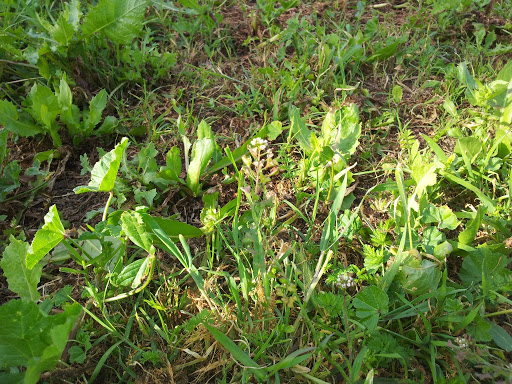
A flower (read: weed) with heart-shaped leaves which caught my attention during the retreat.
Note: Photo was taken after the retreat. |
|