Category: mindfulness

  • The Opportunity Cost of Being a Mindful Mama

    Coming to terms with the new priorities in my life over the first year of parenting has been and continues to be a huge challenge for me. I’m finding it hard to accept that if I’m going to be the type of mother I want to be – mindful, present and intentional – other things need to give.

    In practice, it’s all been pretty natural – my family is number one, health is up there – exercise, sleep, meditation and food alike – and though it’s at a slower pace than before my career is definitely still a factor.

    So what does that look like in practice? Let’s start from the morning – though sometimes I still feel like there’s no real night and day, just the constant flow that I first met almost one year ago when Gadi was born. We wake around 6am and spend an hour or so together as a family. We eat, get ready, chat, cuddle, sometimes dance. This time is precious – crucial to anchor us all together in preparation for our days apart. We head off to daycare and our respective workplaces, where the baby has a ball and my husband and I do our best to do our little bit of good in the world (read: try not to fall asleep at our desks). On the three days a week that I pick Gadi up, we have about two hours together before bath and bed time.

    That two hours feels like nothing. Not nearly enough time to properly reconnect, to ask and tell each other about our days – without words for now. To cuddle and play and eat and wind down. So I put my phone aside, I try to forget about work, and about all the things I want to get done once he goes to sleep. All the phone calls I want to return, blog posts I want to write, work calls I have scheduled for the evening. I want my attention on him 100%, and I want him to see that. Even if I’m just watching him play. I want to teach him about doing one thing at a time, about being where you are – and I think the best way to teach is by example.

    Then we start the bedtime routine – which is sometimes easy and sometimes a bit more challenging and pretty much always exhausting. He’s asleep by 7pm. And to be honest, half the time I fantasize about snuggling up in his cot with him. I’ve been meaning to work out how much weight that thing can support for months now.

    Evenings are important, too. Because when I say that family is a priority – I don’t just mean Gadi. The time that Uri and I spend together at the end of the day is a huge part of what keeps me sane and grounded. What keeps us together. What has made this past year the most amazing one of my life. Often all we manage is eating dinner and chatting on the couch before we both start to fade, but those moments are precious, too. Same goes for an episode of The Big Bang Theory or whatever we can manage to keep our eyes open long enough to watch. We collapse into bed together every night, exhausted but happy, and wake up – once if we’re lucky and three times if we’re not – through the wee hours to feed Gadi and help him get back to sleep.

    One or two nights a week I might “make it” out of the house to meet a friend for dinner or a walk. I keep scheduling yoga classes in my diary for 8pm but I haven’t made it yet – once I’ve got the baby to bed it’s just so hard to get out of the house. I know my body would probably thank me for it but… I just don’t seem to manage it. Maybe once we’re sleeping through the night – if that ever happens. At this point I make it to one afternoon class and one weekend class – and that will have to be enough for now. My semi-regular meditation practice could do with some work too and ditto for running… but c’est la vie.

    And weekends? My priorities don’t change. We love our time just the three of us. Sometimes at home, sometimes out and about, often eating. Most things in our household revolve around food and cuddles – and Gadi’s sleep. We enjoy time with friends and family, too – but nowhere near as much as I used to.

    But my point was neither to share our routine nor to complain about it – I love every moment I just described. That is, unless I slip out of the moment and start thinking about the opportunity cost. About the phone calls I haven’t returned and the parties I don’t attend and the type of friend I used to be. Hour upon hour of phone calls helping my friends and family sort out their issues and mine. Minor and major alike. Bottles of wine. I loved those hours, and I miss them dearly – but I just don’t have them at the moment. Instead I’m choosing to spend them on real, present time with my family, on sleep, and on my own mental health.

    It’s not my new priorities that I struggle with per say – it’s what I’ve had to let go of to put them into place. And I guess in some way I’m still coming to terms with the opportunity cost. I know that this is the way to be the type of mother and wife that I want to be – but at the same time, I miss the me of one or two short years ago.

    When I do finally catch up with the dear people that I used to have so much more time for, I feel pressure to complain. To complain about being tired, and about how hard it is to be a mother, and about the laundry. But honestly, that’s not it for me. My challenge is learning to accept where I am right now, to respect it and embrace it.

    Otherwise, how can I expect anyone else to understand?
  • How to Make Your Mind ‘Body-Shaped’

    The resting pose at the end of pretty much every yoga sequence, Savasana (pronounced ‘Shavasana’ – the corpse pose), is surprisingly difficult to master. Far harder than a headstand, a complicated balance or an intricate bind.

    And yet it’s a crucial pose – said to allow the body to absorb the benefits of the yoga practice, restorative for the mind and body.

    Despite appearances, it’s more that just flopping on the ground like you’re dead. Yes, you need to relax your body. Unclench every muscle, let your feet flop out to the side, really become one with the floor. Surrender the weight of your physicality to the forces of gravity. But the key – as in most things – is in the mind.

    The mind must stay active, present, sharp. And yet restful. Whereas throughout the yoga practice you’ve been noticing your breath, your muscles, your alignment, in savasana you pay attention to the space in between, the resting, the tingling feeling of nothing – of the absence of movement. You seek out that delicate, exact concentration that sits between thinking and letting your mind drift, and hold it steady on the most subtle of sensations.

    So simple and yet so incredibly complicated.

    For many years, savasana was a battle in my mind. Without the active, dynamic flow of yoga on which to to pin my focus, the thoughts came flooding back. And as I ostensibly relaxed on my mat, inside my head I was taking up arms, a metaphorical sword and shield, bravely trying to fight off each thought as it arose. Convinced that this was the game – stopping my thoughts dead in their tracks.

    And then one day a few years ago, I just got it. My mind finally found where it was meant to be and somehow slipped into place.

    I should note that for others – perhaps less Type A than me – the tendency is to drift off to sleep in savasana, rather than to get lost in thought. It’s the same, really – just the other end of the spectrum. Sleep is just as far from the point of this posture as my warrior-like thought fighting.

    Yesterday I was settling into savasana at the end of a fantastic Ashtanga class, and I realized what it is: You need to make your mind “body-shaped.” Instead of letting your mind swish around in your head, where we tend to imagine it lives, you need to pull it down into your body, let it flow down your neck and spine, along your arms and your legs. Squish it into your fingers and toes and allow it to pool in your lower back and buttocks. And then let it settle there and observe.

    Because when it’s “body-shaped” rather than “head-shaped,” your mind can “think” about your body, rather than your thoughts. It can really notice the release in every muscle, the feeling of the body touching the floor, the slow, rhythmic rising and falling of the chest and abdomen. It can be totally aware of the physical relaxation.

    And now I realize – this is true for all mindfulness practice. If you want to be mindful of washing the dishes, you need to make your mind “hands-shaped.” You can’t feel the water on your skin with your head – you need to “think” with your fingers. Same goes for mindful walking, mindful showering – anything you want to do mindfully.

    It’s a mental shift that changes more than just change your “point of view” – it changes the very nature of your mind. From being primarily concerned with thoughts and other mental phenomena like emotions, to noticing the changing sensations of the body. As the father of quantum physics Max Planck is quoted as saying:

    When you change the way you look at things, the things you look at change. 

    It’s a small, conceptual change, but it has tremendous power.

    And in case you’re wondering, no – the irony of my mind imagining up blog posts while it’s meant to be down in my body, focusing on savasana is not lost on me.

    Stay tuned for natural (to me) continuation of this post: How to Make Your Mind “Baby-Shaped.”

  • When Natural Parenting Feels Anything But Natural

    Ostensibly, I’m all into doing things naturally. I read the books, follow the blogs, join the Facebook groups. I breastfeed and babywear. I’ve got the hippy pants. I tsk judgingly from time to time at people who do otherwise (oh come on, admit it – you do too). But sometimes I’ve gotta admit – it feels anything but natural. I feel like I’m stopping myself all the time, trying to find the “right” response, the healthy way to react, the RIE way. That I’m trying so hard to be chilled that my movements end up jerky, that I’m over-thinking and second-guessing every word I say to Gadi, every move. Every time I offer the breast as comfort, take the stroller instead of the carrier, let him taste a cookie out of my hand. Every time I let him fall asleep on me.

    When he was younger it was easier. He stayed in one place, his needs were simpler. All my varied and conflicting sources agreed that there’s no such thing as spoiling a newborn. He just needed me to be there, to tend to his basic needs, to respect him, to love him. And all of that came naturally.

    Now, he’s testing. Not in a behavioral, toddler sense – not yet, anyway – but rather he’s trying to understand sequences, cause and effect. If I do this, then this will happen. And that’s fine, it’s great – I just so badly want to do my bit right that it’s doing my head in. And all of my attempts to be natural and mindful and connected and tuned in are somehow colliding with each other. My mind and my heart and my maternal instincts, all pulling me in different ways.

    There’s a problem with the word “natural,” or at least the concept. We mean so many different things when we say it – the way humans are “meant” to be, pre-industrial revolution, before medicine, without plastic and screens… But the truth is that natural doesn’t feel natural anymore, not in this day and age. What’s natural is what we’re used to, how we were brought up, what we see around us. Perhaps that’s why everything I do ends up feeling like it’s going against the grain.

    I’ve felt it since the beginning of the pregnancy, in some way, shape or form – that I was doing something weird. I’d tell people I was planning a natural birth and they’d look at me like I said I’d decided to birth my (huge) baby out of my left nostril. Exclusively (“only?!”) breastfeeding is somehow seen as subversive behavior, especially past the age of six months, when babies should apparently be eating bucketloads of processed shit sold in tins. And don’t even get me started on Baby Led Weaning. And though these things do feel natural to me – certainly when I think about them and sometimes in practice, too – implementing them can be a bit of an uphill battle.

    I was telling my boss a couple of months back about our efforts to get Gadi’s sleep on track, and our deliberations about whether or not to enlist the help of a sleep therapist. About painstaking lists of bed times and wake ups, books and articles, taking turns and careful routines. Her suggestion? “Maybe you just need to go with it.” I was so taken aback – that’s what I thought we were doing. How did I manage to turn laid back and relaxed parenting into something so anal?

    I like to think – I hope – that these are just growing pains. That just like anything else, it feels a bit awkward at first and then eventually becomes second nature. And of course, it’s not always like this. When I’m really there, right in the moment connected with Gadi, there’s a perfect flow. When I’m responding rather than reacting – yes – but easily, quickly, naturally. Like Victor Frankl put it:

    Between stimulus and response there is a space. In that space is our power to choose our response. In our response lies our growth and our freedom.

    Deep down, I know the fact that I’m thinking about all of this means I’m being exactly the type of parent I want to be – a mindful, intentional parent. That I’m trying things out, seeing what fits. I also know that it’s when I’m living in the past or the future – going over and over things that happened or trying to plan out the future move by move – that this conflict exists. In the moment, when I’m really present, everything is great.

    But in the meantime, it’s hurting my poor tired brain.

  • My Juggling Act

    When I named this blog, I thought I was performing a juggling act. I thought combining a career (not even a job! I was in between positions at the time), a meditation practice, a relationship and a social life was a feat to be reckoned with.

    *Cue hysterical laughter*

    I had no idea.

    The month before last I went back to work full-time, after seven months on maternity leave. Followers of this blog might have noticed that I haven’t posted since then. It’s actually more full on than that – I haven’t even thought about posting since then. Usually in even my least prolific periods I’m still dreaming up blog posts, writing them in my head as I walk or exercise – even if they never end up being typed, let alone published.

    No, this is a whole new level of juggling. There’s work, which is the same as it was before, I suppose, but I have far fewer brain cells and working memory to get it done. I have loooong moments of staring at the screen thinking “fuck! I have no idea what I was just working on.” There’s a baby – an amazing, smart, hilarious 9-month-old baby, who still wakes up to feed at least once a night, is still running his strange laundry-making scheme (I’m yet to work out how someone so small makes so much laundry). There’s my guilt that I’m not with him for 8 hours every day, that he wonders where we’ve gone and when we’ll be back. That guilt alone takes up more of my being than half of the stuff I thought I was juggling before. There’s my then-boyfriend-now-husband, who’s actually the easiest thing on this list of things to juggle, since without him there would be nothing else. Just a pile of balls on the ground. There’s still practice – both meditation and yoga – but they’ve taken a back seat. Twice a week each and I’m happy – with bonus points if I managed to stay awake through all four sessions. Thoughts of running filter in but seldom make it to my sneakers. Social life? Funny. There’s a lot more ice cream than before, though. We like ice cream a little too much.

    I’m guessing that in a few years time I’ll look back on this and think “ha!” she had no idea. And it will be true. I don’t.

  • Tricks of the Mindful, Part II

    Several weeks after writing about my efforts to mindfully release some painful thoughts, I’m pleased to report marked success in the next phase of my little operation. Whereas a few weeks ago I was really suffering over a crisis with my relative, Vanessa, I now feel much better about the situation, and have even managed a calm conversation with her to share some of my feelings – without pointing fingers or dredging up the issue.

    To recap, the first step was to mindfully note whenever the thoughts in question arose. This helped to distance myself from the mental churning, and even stopped thoughts dead in their tracks at times. To neutralize the threat altogether, I planned to cultivate some “lovingkindness” or compassionate thoughts – by consciously reminding myself of how much I love Vanessa and her family, every time the topic arose in my mind.

    Full disclosure: In the meantime, some events transpired that helped put things in perspective. Birth, death and war – would you believe. The big things that have a habit of making us realize how little the little things really are.

    In any case, back to the second step, the lovingkindness plan: Each time I notice a thought about Vanessa, I note it as above, and then I take a deep, slow inhalation. As I inhale, I imagine I’m breathing in love and kindness – simple as that. Yes – it feels a bit contrived, I’ll admit. But it’s working. I’m noticing more and more that the thought is followed by the realization of it – rather than seconds or minutes of stewing angrily – and then almost immediately, feelings of forgiveness and kindness start to bubble up before I even start my dorky love breathing.

    On top of these changes, I’ve noticed a pleasing by-product. Little by little, my mind is starting to follow these simple steps for all sorts of scenarios – before getting sucked into going over unpleasant situations. Instead, I’m noticing a spark of looking for the good in people, an almost undetectable deep inhalation of lovingkindness. They’re just glimpses of progress at this point, but I’m optimistic that they will grow.

    Ultimately, I know I can’t control my thoughts – that understanding is one of the main gifts that I’ve received from mindfulness meditation. But I can choose how I react to them. And more than that – I can create the conditions for thoughts which serve me well to thrive – and work out ways to minimize the damage caused by thoughts would do me harm.

    Peace of mind, here I come. Piece of cake (almost).

  • Gadi’s Journey to Sleeping Through the Night (and Rocket Alert Sirens)

    Third post this month on sleeping! Seriously who am I? If you would have told me a year and a half ago that these would be my blog posts I wouldn’t have believed you. And yet here we are.

    So, after a fairly difficult month last month with Gadi’s sleep (and my own little slumber realization, to boot), a war raging in the South, and moving apartments this past weekend, it looks like we’ve finally turned a corner for the better – in the sleep department, that is. Of course it could be a total coincidence – that whatever developmental leap he was going through, tooth movement he was suffering from or whatever else ended exactly at the same time as we decided to take action. Anything’s possible. But let’s just pretend for a moment that I have some kind of control here, shall we?

    About three weeks ago, we decided enough was enough – that an hour of screaming before bed, shrugging our shoulders and trying to laugh about the fact that we no longer had any idea how to help our baby go to sleep was not gonna fly anymore. We formed a plan to give Gadi some firmer boundaries around bedtime, while still keeping the flexibility that seems to work for us. We chose an earlier bedtime (7:30pm) and a little routine (bath, massage, book, feed, bed), and decided to give it a week and see what happened before considering talking to a sleep consultant.

    And miraculously, within a matter of days it became downright easy for me to get Gadi to sleep. (If anyone has a direct line with fate please don’t pass on this blog post – tfu tfu tfu, throw salt over my shoulder, kiss the evil eye etc.)

    There’s the main points that really helped us.

    • Recognizing overtiredness. We ended up moving bedtime to 6:30pm and even though he usually wakes for another feed around 7:30pm, both times going back to sleep is a breeze. I was making the (rookie) mistake of thinking that crying meant he didn’t want to go to sleep – while in fact the opposite was true. All that crying around bedtime actually meant that I had missed the window.
    • Connecting day and night. By the same token, the only way not to end up with an exhausted baby at the end of the day is to become a Sleep Sergeant 24/7. For Gadi, that means as soon as he’s been awake for two hours – it’s nap time. And all things being equal (ie if my own comings and goings don’t get in the way), he generally starts showing signs of tiredness like clockwork – 120 minutes after waking up.
    • Looking for what’s missing. One day I was watching him struggle to fall asleep, and it dawned on me that his flailing around might be related to a need to be more snuggled up. In 30 degree heat and at 5-months old I thought he was too old and too warm for swaddling or much clothing (if any). Turns out blasting the air-conditioning for a couple of hours before bed and using a thin sleeping bag was just what the sleep doctor ordered.
    • Confidence. It’s really easy to question yourself with a crying baby twisting and turning in your arms. Trust your instincts and your baby will, too. Question everything you do – and I’m guessing your baby will do that, too. Less than ideal. I found consciously reminding myself “he is tired, he needs to sleep” really useful, as well as helping Gadi understand those feelings too – “you’re having a hard time winding down bubba, I know. But you’ll get there soon and you’re gonna feel SO much better when you wake up.” I know he probably doesn’t understand my words but I like to think there’s something about the tone that does come across.

    To finish the story, we have now moved apartments, and Gadi moved straight into his own room. As I suspected might happen, he seems to have quite taken to it – and last night he slept through the night. His last feed was at 8pm, at 10pm I carried him out of the apartment sound asleep to take cover during a rocket attack (surreal, yes), and at 5am I woke up to hear him singing, happy shrieking and clicking his tongue down the hallway. Amazing. I was so excited I woke my husband up to tell him – kind of defeats the point, I know. But seriously, I couldn’t be prouder if he’d gone and got a Harvard Law Degree while I was sleeping.

    Of course, I know this too will pass; there will be more sleepless nights and the next challenge is just around the corner. But I feel that I learned a lesson in conscious parenting here – and I have my husband to thank for bringing up the issue and pushing me to do something. There’s a lot we can’t control when it comes to babies (and life in general) – but being mindful of our actions and setting some firm but flexible boundaries can go a long way.

  • A Loving-Kindness Meditation for Today

    At a bit of a loss for what to do with myself between packing up our apartment (moving this week), playing with Gadi (currently sleeping) and listening out for the next rocket warning siren (last one in Tel Aviv was about 18 hours ago), I decided to sit down and shut up. I usually end each meditation session with a few minutes of lovingkindness (metta) meditation. Here’s what I did today:


    May I be happy;

    May I be peaceful and harmonious;

    May I be liberated from suffering;

    May I be healthy and free.


    May my family be happy;

    May they be peaceful and harmonious;

    May they be liberated from suffering;

    May they be healthy and free.


    May everyone in Tel Aviv be happy;

    May they be peaceful and harmonious;

    May they be liberated from suffering;

    May they be healthy and free.


    May all Israelis and Palestinians be happy;

    May they be peaceful and harmonious;

    May they be liberated from suffering;

    May they be healthy and free.


    May all beings be happy;

    May they be peaceful and harmonious;

    May they be liberated from suffering;

    May all beings be healthy and free.


    And for bonus points (NB: points not redeemable for anything tangible):

    If I have harmed anyone, intentionally or unintentionally, I ask forgiveness.
    If anyone has caused me harm, intentionally or unintentionally, I offer peace.
    If I have caused myself harm, intentionally or unintentionally, I forgive myself.


    Practicing metta meditation is pretty simple. It’s not a magic spell or prayer; just about creating some good vibes (I’m buzzing a bit now). If you feel inclined: sit down comfortably, straighten upwards, and focus on your breathing for a bit to settle into the present and give your mind a moment to quiet. If you have a regular meditation practice you can also do that before or after – whatever feels right to you. Then repeat the lines above quietly to yourself, in your heart. Repeat or ponder if you feel like it. Bring your mind back if it wanders. Feel the lovingkindness grow in and around you. 


    May all beings be happy, peaceful and free. 

  • Redefining the Four-Month Sleep Regression

    Ever since my peers started having babies, I’ve heard about the ‘Four Month Sleep Regression’ – generally defined as “just when you think you’ve got a handle on getting the baby to sleep, everything goes to shit.” And there’s definitely something to it – our four- (almost five)- month-old has been going through some big changes over the past few weeks – and as a result his sleep has been negatively affected. Whereas not long ago we were able to put him in cot drowsy, sing a little and say goodnight and he’d drop off by himself, now bedtime can be anything from him passing out on the boob, to a full hour of inconsolable screaming (usually ending with him falling asleep on the boob). And this goes for daytime naps, too.

    Nonetheless, I’m here to assert that this trying phase deserves a new name. I strongly believe that how we term and frame things shapes our experience – and that by choosing better words we can opt to bring more enjoyment and less suffering into our parenting.

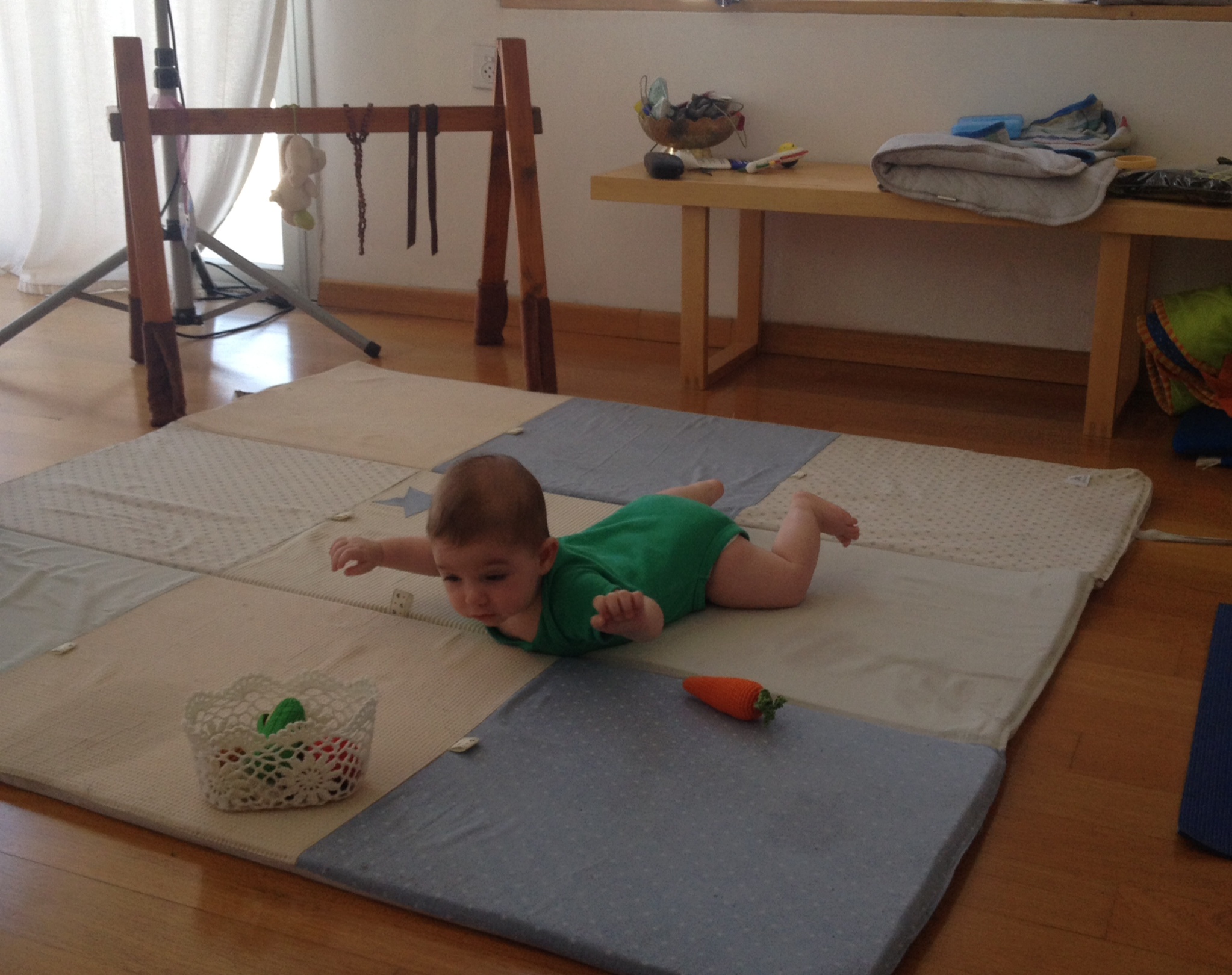
    Over the past few weeks, Gadi has been going through some crazy leaps and bounds in his development – both motor and cognitive. When I’m not playing with him, doing the laundry, feeding or writing, I’m loving just watching him learn and explore. He does this adorable little skydiver move, on his tummy with his arms and legs out and up, he giggles and chats and dribbles. He reaches for toys and gets entranced by noises and colors. To my reading, this huge influx of sensory information is keeping him wired, making it more difficult for him to relax enough to get to sleep. And I totally get that; I know that when huge things have been going on for me – like covering massive news events in years gone by, for example – I’ve found it pretty hard to wind down and drift off to sleep.

    Why sleep when you can skydive?
    Why sleep when you can skydive?

    But why frame all of this as a negative? What we’re actually seeing is a developmental leap which we should be celebrating – not a regression. Gadi hasn’t stopped rolling over and he doesn’t babble to himself less – he’s just having some sleep disturbances. When our teenagers turn into maniacs during exam time, or our friends turn into Bridezilla during the stress of planning their dream wedding, we don’t say they’re having a regression – so why do it to babies? I think this ill-conceived concept that development is perfectly linear is playing a huge part in how difficult we experience these admittedly difficult patches.

    Of course, it’s not just the words – it’s the mindset that comes with them. When we expect that everything will stay the same and refuse to roll with the ebb and flow of life, or that we’ll get more and more sleep or time to ourselves as time goes by, we’re kidding ourselves. And to be totally honest maybe it’s even kind of selfish. We made the decision to have kids – surely we anticipated some rough patches? Maybe really it’s us, the parents, that are having a regression when we view tough times without context, without zooming out to remember the big picture. To quote the Buddha:

    Pain in life is inevitable but suffering is not. Pain is what the world does to you, suffering is what you do to yourself. Pain is inevitable, suffering is optional.

    And so, in an effort to take out the suffering, I propose: The ‘Four Month Super Leap’! Who’s with me? Let’s marvel at our babies’ progress rather than getting ourselves all bummed out about a bit of screaming and tiredness.

    One last thing: I highly recommend whipping up a batch of these delicious chocolate chili vegan cookies. They’re full of sugar, granted, but hey – they’re keeping me buzzed and happy at the present moment so what the hell. Just try not to leave out the baking soda if you can manage it – my first batch suffered from a severe baby brain-induced softness regression.

    20140626-104309-38589801.jpg
    Gotta just go with it – HRH Gadi takes the bed.
  • Tricks of the Mindful, Part I

    There’s a personal, family situation that’s bothering me at the moment – swimming around and around in my head against my will, despite my having decided numerous times not to confront the issue. A few moments free to mull and my mind inevitably ends up there, rehashing an extremely uncomfortable conversation that took place a few months ago, drafting emails and SMSes that I will never send, scripting phone calls I will never make, and imagining responses that will never eventuate.

    With the dispute itself months in the past, it’s no longer my relative that’s making me feel bad; now it’s my mind – dredging up uncomfortable feelings over and over again in some sort of demented, hopeless effort to make me feel better. Such is the mind; we are largely powerless to control the thoughts it entertains. But I do believe we can nudge it in the right direction, and that’s what I’ve decided to do with this little battle.

    The first step – as is often the case – is awareness. Every time I notice the chatter in question – whether I catch it a second or a few minutes in – I note it. I mentally say to myself “thinking about Vanessa*” And surprisingly, the effects have been almost immediate. By naming the occurrence, I am straight away distanced. It becomes clear that it’s my mind – and not ‘me’ – which is going over and over things, and I am able to walk away from the noise in a way that I haven’t been even vaguely successful in doing so far. It totally, magically deflates the process, takes the pain out of the mental churning.

    The bottom line is that I do want my relationship with Vanessa to be better, to get back to normal. After literally hours of talking, thinking, and writing, I’ve decided not to do anything further about our disagreement and just get on with things, but my mind hasn’t caught up. So inevitably, thoughts of the conflict keep arising. Rinse and repeat – I note the self-chatter and it simmers down, again.

    But this noting alone won’t be enough to make things right. I still need to find a way to feel better about it all – to cultivate lovingkindness, rather than hurt and anger, into my thoughts and feelings about her.

    Here’s the plan: Every time the thoughts in question come up and I shine a light on them, I will add in a conscious, positive thought. Something about how much we care about each other, and about her good (though misguided) intentions. I’m hoping I can gradually take the sting out of the conflict by massaging my mind in this way, so that eventually the thoughts can just flicker by like the host of other crazy shit that goes through my head, without getting stuck on the big screen, so to speak. And in time, they’ll be gone, or at least barely noticeable in the babble of everyday life.

    Stay tuned for Part II to see how it goes.


    *I don’t know anyone called Vanessa; I totally made up that name. The rest of the post is true, though.

  • Farewell, Elissa

    I woke up this morning to find my Facebook news feed filled with photos and posts about Elissa Froman, and realised that the inevitable had happened – that this beautiful person who I knew for but a fleeting moment had lost her brave, years-long battle with Hodgkin’s Lymphoma and passed away last night.

    I met Elissa in Jerusalem in winter 2005, when we were both studying at the Hebrew University and living in questionable makeshift dorms in the Jerusalem Gate Hotel. I met so many people over that period, all varied and interesting in their own ways, and yet somehow my memories of Elissa never faded. One that stands out is the hours she spent holed up in her dorm room helping me memorize a parsha for my little sister’s batmitzvah that year. She was patient and knowledgeable, and somehow got me ready though I’d never chanted torah before, and both of us had a million things we’d rather have been doing. This woman was wise behind her years, funny and sharp, always with a kind look on her face and a twinkle in her eye.

    Over the years since I’ve met countless people across Israel who knew Elissa – whether they grew up with her in Chicago or like me simply had the honor of having met her – and the impression is always the same. She touched everyone she met, plain and simple, and I’ve felt instantly linked having Elissa as a common bond. A glance down her Facebook page today shows hundreds of heart-wrenching quotes from friends and acquaintances alike, all remembering this strong, inspirational woman. Elissa held a special place in the hearts of everyone she met, and I know she always will.

    I hope her family and friends can find solace in the fact that she suffers no more, and celebrate her life as they mourn her loss.

    Shalom, chavera.

    Elissa and me in Jerusalem, January 2005