Category: pregnancy

  • My Muddled Up Sandwich of Grief

    My Muddled Up Sandwich of Grief

    Yesterday marked two months since I had the procedure to terminate my third pregnancy. My second miscarriage at 6 weeksย earlier last year. My first was about as successful as they get – GG turned two last week.

    In the days that followed that horrible ultrasound, I was in shock. I cried and I was sad, but overall I felt okay. I talked a lot about gratitude, acceptance and counting my blessings. And that was important – to get me through everythingย I needed to endure that week. Somehow I eased back into regular life, unsure if maybe I hadn’t cried enough, felt enough, mourned enough.

    And then a month later, there it was. A big-ass emotional crash. I cried more – a lot more. I was plagued by thoughts like “maybe there’s something really wrong with me” and “three years ago I was normal and now I’m broken” and plentyย of “fuck fuck fuck, I can’t believe that happened!”

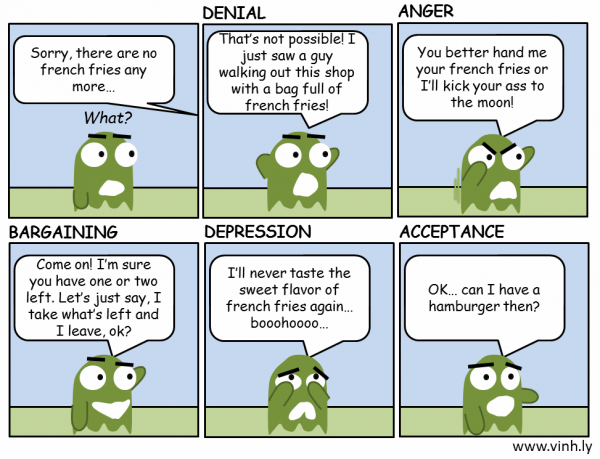
    Iย was obsessed with giving it a name, explaining what was going on. I’d been fine and now I was losing my shit – what the hell? I kept googling theย Stages of Grief and getting myself all muddled up, trying to figure out where I fell in the process.ย This cartoon I found in such a googling frenzy seemed toย sum up the accepted process:

    The-5-stages-of-grief1-e1373497045473

    But it didn’tย feel like that to me. Iย wasn’tย going through stages – I was just grieving. Layers ofย sadnessย on top ofย denial spread withย shock, and some acceptance sprinkled on top. It’s not a five-part course with an “over it” certificate at the end. It’s a grief sandwich.

    I accepted both pregnancy losses pretty early on, straight away even – to some degree. And yet denial lingers. Aย part of meย looks forward to getting pregnant again as getting “back on track” – rather than starting a totally separateย pregnancy. I still wear maternity clothes sometimes. Okay, most of the time. I say they’re just more comfortable (and they are), but I wonder. It’s like I’m just holding my breath, hoping to put three pregnancies together to make one healthy baby.

    That crash last month – that was depression. I mean, I would use the word sadness rather but either way, I was feelingย the loss in my heart – and it made the whole world around me look horrible. It was aย heavy, dark feeling in my stomach that bubbled to the surface and stuck around for a good couple of days. And with those feelings came a serving of anger, too – though it probably didn’t get directed at the right source. Sorry dear husband.

    What I’ve realized in the weeks since is that the labels don’t matter.ย I’ve made an effort to create some space for these feelings to come up and play themselves out – time that I’m not at work or with GG. Lots of yoga and good food and even some time alone when I can snatch it. A quickย getaway with my husband and this stunning view worked wonders:

    Looking out over the Ramon Crater

    It’s a weird kind of grief, this pregnancy loss. So disappointing and sad, and yet tinged with hope – for the next one. The truth is – I think my acceptance will only be complete onceย I have a healthy baby in my arms.ย Hopefully sooner rather than later. In the meantime, this is where I’m at – still in the thick of it but better and better every day.

  • Musings on Blood, and How Being a Woman Is Just Freaking Weird Sometimes

    Musings on Blood, and How Being a Woman Is Just Freaking Weird Sometimes

    No one wants to admit it, but it’s true. This whole childrearing thing, it’s a veritable freak-show for the female body.

    I’m thinking about blood today, having just got my first period since terminating a pregnancy for medical reasons just over a month ago. Oh – I guess this is the bit where I warn you that I’m going to talk about blood coming out of vaginas in this post. Anyone who wants to pretend this doesn’t happen all the time, or thinks it shouldn’t be spoken about should probably opt out around now.

    So today, I’m filled with excitement and relief – seriously I think I might feel happier than when I last found out I was pregnant. How weird is that? It makes sense, of course – I’m relieved to know everything’s working, glad to stop wondering when it’s coming, excited to try again etc – but still, there’s something decidedly weird about it.

    And this isn’t the first time I’ve had this realization either. When I started bleeding during my miscarriage earlier last year (yeh, it’s been a fun few months), I felt exactly the same way. I’d been concerned that the pregnancy might be ectopic and really wanted to avoid surgery and/or medication, so knowing that my body was sorting it out made me really happy.

    As I celebrate today’s blood, I’ve been musing over this journey that ‘the fairer sex’ goes on with the red stuff.

    In Western society, we tend to receive our first periods with a sense of dread. We learn about the equipment needed to deal with this annoyance. We read Judy Blume’s Are You There God? It’s Me, Margaret. We hide what’s going on from the boys and men in our lives. We feel awkward and broken and alone.

    A few years later once we start having sex, the arrival of our monthly blood comes with a sense of relief – we did it! We avoided getting pregnant and don’t need to admit to the adults that we’re having sex! And of course the awkwardness persists – we still hope swimming parties don’t fall on days when we’re bleeding. We master tampons. We avoid boyfriends during our time of the month so we don’t have to discuss our monthly disability. Or maybe we’re among the more liberated of women, and we do talk about periods – even to men. Maybe we like having sex during our periods, and we have to deal with weird looks and wives tales if we’re brave enough to talk about it.

    And then five or 10 or 20 years down the line we start thinking about kids, and again, the blood takes on a different meaning. We get more in touch with our bodies and (hopefully) come to appreciate a regular cycle. We get off birth control and notice differences in our physical selves. Perhaps we start to appreciate this blood for what it really is – a part of our complex and brilliant reproductive systems, rather than just a monthly nuisance.

    When we’re actively trying to get pregnant, the period takes triggers different emotions again. Now the blood signals failure, disappointment. It means we didn’t get pregnant, not this month. It means we’ll have to wait at least another month for that coveted positive pregnancy test.

    All going well, at some point we do indeed miss a period, yay! But the thought of blood is still there at the back of our minds, always. As we tick off those days and weeks of the first trimester, holding our breaths every time we wipe, just hoping not to see anything red.

    And meanwhile the blood is all just building up in there, providing a cozy home for little blastocysts and then embryos and then fetuses… until eventually we’ve got a baby in our arms, and week after week of bleeding that makes us cackle evil laughs thinking about how we used to complain about our periods.

    And I can only imagine, on the other side of childbearing and childrearing, after menopause – what happens then? I guess I’ll have to write a follow-up post in a few decades.

    Either way, it’s clear – this whole being a woman thing is a weird and wonderful journey. But despite the highs and the lows, the physical and emotional pain, and the gruesome nature of it all, I feel pretty grateful to be in this body, on this path. Every cramp I feel as I’m writing this fills me with a sense of hope and empowerment, and a connection with the women of the world – past, present and future.

    One day, I hope to tell my imaginary future daughter: embrace this bleeding! Each and every time. Let it anchor you to the strong women in your life who inspire you, and to a future in which you get to join the sisterhood of mothers. It’ll be the most important, life-changing and empowering thing you ever do – and all that blood will be more than worth it.

  • How Meditation Got Me through another Pregnancy Loss

    This wasn’t the blog post I wanted to write.

    The blog post I wanted to write was about early pregnancy – particularly early pregnancy right after a miscarriage. It was about overcoming my anxieties, exhaustion and nausea, about gradually feeling more and more confident that everything would be okay.

    But I never got around to writing it. This is a different post.

    This post about how the skills I’ve learnt from meditation over the past 10 years seem to have equipped me to deal with a second pregnancy loss.

    The week before last I was 15 weeks pregnant. My husband and I went in for a scheduled ultrasound excited to find out if we were having a boy or a girl. Instead, we found out that the fetus had a serious defect in the skull, and were advised to terminate the pregnancy.

    That was two weeks ago now, and somehow here I am on the other side of it all. The shock of the diagnosis. The weight of telling friends and family (on my birthday, no less). Through three horrible days of feeling fetal movement and knowing what was to come. The procedure itself. Hours of sobbing.

    And somehow, I’m ok. We’re ok. Our little family is stronger than ever. And the sky is still up there. Somehow.

    I’ve been going back and forth about how to write this post. How to word it so I’m best understood. And today I realized – everything that got me through this experience, I gained through meditation. Through dozens of Vipassana retreats and Dharma books. From the wisdom of teachers who brought Buddhist contemplative practices to the West. And from the simplicity of meditation practice itself.

    Through meditation I learned the power of being present. I’ve learned how to center myself in the moment and to find out if everything is ok – and I’m yet to find a moment where it’s not. Once I filter out all the bullshit, all the noise in my head, everything is always ok. Even in that terrible moment, when the ultrasound technician shook his head, looked up sadly and said “the head hasn’t formed properly, I’m sorry.” Even then, somehow, everything was ok.

    Through the practice of Vipassana I’m learning to come to terms with the reality of my human body. That it will get old, it will decay. Just like everyone else’s. That shit will go wrong. And rather than being sad and horrifying, that knowledge can be a comfort. Liberating, even. The knowledge that my body is just like every other body. That things that happen to other people – random, horrible, unwanted things – can happen to us, too.

    But it’s more than just accepting my body. Through this  practice Iโ€™m learning the art of accepting reality as it is. Even when I donโ€™t like it, and I wish it was otherwise. Iโ€™ve learned how to identify when the pain I feel is stemming from my refusal to accept the facts of my situation โ€“ from wishing something was different than it is. Something out of my control. And conversely, Iโ€™ve experienced the release and freedom that comes from surrender. From giving up the fight that doesnโ€™t really exist to begin with.

    Through meditation I’ve been exposed to the art of gratitude. To focusing on the โ€œwhat isโ€ rather than the โ€œwhat isnโ€™t.โ€ I’ve been constantly surprised by just how much gratitude has naturally come up in my heart and my head during this whole experience.

    I’m grateful to live in this age of medical science that can detect defects (relatively) early on in a pregnancy, and provide safe options for termination. Thirty years ago, this pregnancy would have continued to full term and the defect would only have been discovered at birth. The baby would not have survived. Thirty years ago, I donโ€™t think my meditation practice would have done shit to make me feel better.

    I’m thankful for my beautiful little family. For my eternally supportive, patient, rock of a husband and our beautiful son. We want another baby and Iโ€™m sure we’ll have one very soon, but even if we never do – that’ll be okay too. It’s not a tragedy. The three of us are healthy and happy – so happy – and that’s more than enough.

    Through meditation Iโ€™ve learned that nothing is solid. Iโ€™ve practiced looking deeper and deeper into sensations โ€“ physical and emotional, alike โ€“ only to discover that everything is always flickering. Even in the midst of despair there are moments of happiness. With this understanding, Iโ€™ve learned to feel sadness when it arises, to be with it and acknowledge it and let it run its course, and then to leave it and move on with the next sensation that comes up. To be with my pain when it arises, and then to equally be with the pure joy of our 2-year-old son whenever he bounces in the room. I’ve learned that while I don’t have the power to control what emotions arise, I can take responsibility for my reactions to them.

    To be clear: this diatribe on the glory of meditation is not to say that this situation doesn’t suck โ€“ it does. It sucks big-time. There have been many moments and minutes and hours of sadness and disappointment. Tears and sobs that come from deep within, seemingly out of nowhere. That sinking feeling of โ€œI canโ€™t believe this is happening to me.โ€ The unfairness of it all. To have to terminate a pregnancy right after a miscarriage. I mean come on. But when these moments pass, they pass. I take a deep breath, wipe my face, and then move on (usually to a block of dark chocolate).

    Sometimes, I feel like I’m kidding myself. Like I haven’t cried enough. Like maybe the worst is yet to come. Like this whole line of thinking is all bullshit rationalization and bravado and that actually I’m so broken inside that I can’t even see it.

    And that might be so, I suppose. Only time will tell. But right now, in this moment โ€“ this long, eternal moment โ€“ everything is ok. For once, it seems like my mind is on my side.

  • Miscarriage… and Somehow Life Goes On

    I had a miscarriage last month. It was early, around six weeks, and resolved itself naturally. It was a two-week emotional rollercoaster – telling our parentsย and a fewย close friends that I was pregnant and then in a matter of days finding out that the hormone levels had plateaued and the fetus didn’t seem to be developing. A little scare when some tests indicated that it might have been an ectopic pregnancy, and then a huge relief a day later when myย doctor calmed our fears and my body started to pass the pregnancy.

    Two weeks later, and I’m so at peace with it that I find myself worrying I’m in denial.

    It’s just… okay. It’s not a tragedy – it never felt like one to me. I felt like we lost a pregnancy – not a baby. Maybe because it was so early, or because we never even saw the heartbeat – there probably never was one. Or maybe because we have a beautiful toddler running around, full of life and joy and silliness, and to be honest even if we never have another kid it will still be okay.

    As well as looking at my life, I’veย constantly been thinking ofย the strong, resilient women around meย who have gone through so much tougherย challenges in their childbearing journeys. And honestly, each and every one of theirย situations seems so much harder than mine. So I’m mindful that a big part of the reason this miscarriage didn’t knock me flying was that really – it just could have been so much worse.

    There’s something about statistics that keptย running around my head, too – we’ve all heard the numbers about how common miscarriages are, especially at this early stage. One in four or five according to most sources. There’s something very grounding about the realizationย that I’m just as normal as everyone else – just as susceptible to the forces of nature.

    Of course, there were big emotions – don’t get me wrong. I was beside myself for an entire day, an uncontrollable sobbing mess. Just when I thought I had my shit together a new wave of grief would rush over me and I’d be down for another hour. Thick, heavy sadness. Plain and simple.

    And there was a bunch of fear, too. Fear of what would happen to me physically, fear of how nervous I’ll feel if/when I get pregnant again. And a mix of fear and sadness for some sort of lost innocence, a chipping away of my formerly formidable trust in my body. My husband helped me out on that one actually, gently correcting me when I’d expressed a fear of what would happen to my body – instead urging me to think about it as something my body would do. So spot on. From that momentย I was oddly looking forward to theย bleeding, to get that reassuranceย that my body was sorting it out, completing the process of terminating a pregnancy that wasn’t working for whatever reason.

    The next dayย I was a mess for about half the day, and then only a couple of hours the day after that. And then the beginning of the week rocked up and I went back to work, figuring that worst case scenario I could jump in a cab and come home if I started feeling uncomfortable – physically or emotionally. And indeedย there was a weird sensation about being at the office – like, why am I having benign conversations around the water cooler while I’m in the middle of a miscarriage? But it still felt like the right move.

    Because what was the alternative? Sitting at home and dragging out the drama, holding onto painful emotions, making myself feel bad when for the most part I felt fine? When the sadness crept back in I felt it, respected it, and just let it pass – and it always did. Happiness always settled back in – along with anger and annoyance and all those other everyday feelings, of course.

    So eventually I had a few days of bleeding with mild contraction-like cramps – not much more than a heavy period, really – and it was done. I had a couple of tests, got the all clear, and I feelย good now. Inside and out. Liberated, somehow. Like I got through something massiveย and waddayaknowย – I came out the other side okay, and maybe even a little wiser for it. As is often the case, the fear turned out to be so much worse than the reality.

    I hope I can keep this calm,ย level feeling with me into another pregnancy in the near future, as anย antidote to the anxieties that inevitably accompany the fertility and conception process. To keep in mind that even if something does go wrong, I – we – can handle it. Mindfully, honestly, and with as much ice cream as necessary.

  • A Pelvic Floor Story

    I graduated vagina training today. Yes, you read that correctly. And yes, I’m going to be using words like ‘vagina’ in this post, so if you don’t think you can handle it now is probably a good time to hit that little ‘x’ up there in the righthand corner.

    Of course, the use of the word ‘vagina’ here isn’t entirely accurate. I graduated from pelvic floor physiotherapy. And when I say “graduated”… well, there were no caps and gowns. But I did finish a course of physiotherapy to rehabilitate my pelvic floor from an injury sustained in pregnancy and birth. Or a few injuries, I don’t know exactly how to classify it. Maybe my fantastic physiotherapist Zoe can write a guest post and explain what the hell happened down there. In the meantime, I’m going to share my story, what I’ve learned, and hopefully get a start on realizing my newest mission – to raise awareness for the pelvic floor, both literally and figuratively.

    I’m now 13 months post partum. I had a natural, fairly uncomplicated birth which resulted in a beautiful, 3.8kg baby, enough blood loss to send my hemoglobin levels way down and my heart rate through the roof, and some second degree tears for good measure. How many stitches? I vaguely remember asking the doctor how many I would need and he basically laughed at me. It took him an hour to sew me up. So in a nutshell, after the birth I was – apart from being the happiest woman on earth and completely in love with my new little family and all of that – totally wiped out and experiencing a lot of pain, especially when sitting.

    But the physical stuff is only part of the problem. A small part even, I would say. The real problem was in my head (surprise!). In my mind, I was meant to be back to my old self in a couple of weeks. A month, tops. I even planned a wedding for five weeks after my due date (yes, Gadi was five weeks old at our wedding. And yes, I’m insane). On the surface, it all turned out fine. I managed to walk down the aisle, stand up for a few hours to mingle at our chilled brunch wedding, but looking back – I want to scream “what was I thinking?!” Why didn’t anyone tell me to stop climbing up and down the four flights of stairs to our rooftop apartment twice a day, lugging a growing baby, groceries, accessories and whatever else. To sit the fuck down and go the fuck to sleep. Well, anyone apart from my dear husband of course. He told me to go to sleep all the time, but I don’t like being told to go to sleep so you can imagine how well that turned out.

    Maybe I was an extreme case, but there is definitely an expectation in Western society that women are meant to be getting ‘back to it’ as soon as possible after giving birth. Back to socializing, keeping house and cooking. Back to their bodies. Back to sex. All I’ve got to go on is my own experience, but I don’t think it’s healthy. Women need to rest after birth – and their newborn babies need milk and cuddles and sleep, so snuggling on the couch or in bed is pretty much perfect. Next time around – I’m not leaving the house for a month. Bugger anyone who tries to convince me otherwise.

    But back to my pelvic floor. So I overdid it, and probably made things worse – but who knows, maybe if I had rested up properly I still would have sustained these injuries. Anytime I was on my feet for more than about half an hour I would have this heavy, aching feeling in my pelvic floor. A dull, downward sensation, kind of like period pain. I never thought of it as painful, but I did often have to stop and sit when I was out and about – it was uncomfortable to say the least. And yet for some 10 months, I didn’t do anything about it – I think because I was embarrassed. Or because I thought that it was normal and it would just get better. I’d “passed” my six-week check up, after all – so surely that meant everything was okay and I didn’t really think that much of it. Especially since I’d been such an advocate of natural birth, such a believer that my body was made to grow and birth this baby. I felt like it would be conceding defeat to admit that actually, pregnancy and birth had left me injured.

    It wasn’t until I was starting to experience some uncomfortable symptoms of pelvic organ prolapse that I finally decided to see my ob-gyn and ask her what was up. Naturally, between scheduling the appointment and going to it I also did a bit (ok, a lot) of googling, self-diagnosed the issue (rightly, as it turned out) and discovered that a whopping 50% of women experience some form of pelvic organ prolapse – either as a result of childbearing or later on during menopause. And yet I’d never heard about it. And neither had the majority of the women I’ve brought up the issue with in recent months.

    The pelvic exam was straight-forward. I mean let’s face it – after giving birth, a trip to the ob-gyn is pretty routine. Squeeze, cough, bear down, and a few minutes later I was diagnosed with a super weak pelvic floor and some moderate pelvic organ prolapse. I was given a referral for pelvic floor physiotherapy, reassured that this was almost entirely repairable, would not affect future pregnancies or births, and was not a dangerous condition. And so off I went to vagina training.

    It was amazing what a difference the first few sessions made. I learned proper awareness of this frankly fascinating muscle, and with daily practice was able to alleviate the symptoms in just two weeks. Two months on and I am feeling great, finally back to my ‘old self.’ Though the muscle is still weak, I know what to do to strengthen it and don’t need any further sessions.

    I should mention – if the ob-gyn’s examination was par for the course, vagina therapy certainly was not. Which was probably why I had to make up a name like vagina therapy – to deal with the awkward reality of a full one-hour pelvic floor workout, with either a hand or an electrode inside me most of the time. “And contract, two, three, four, release, two, three, four.” Sometimes I even had the pleasure of electric shocks up my vagina – I didn’t like that one very much. But the biofeedback was fun – beating my high score each week totally gamified the process for me. (Yes, I may have a competitive streak.) My physiotherapist did everything she could to make it as comfortable as possible – we chatted most of the time – but there’s nothing to be done, there’s just something inherently awkward about the whole process.

    Or is there? There’s nothing awkward about getting physio on your leg, right? If I had an accident and the muscles in my arm needed an hour’s worth of stitches, surely going to physiotherapy would be pretty standard. If only it was the same for the pelvic floor, maybe women wouldn’t be needlessly putting up with pain and discomfort after birth.

    And this brings us to my mission to normalize and raise awareness for pelvic floor issues, and my PSA. To women of all ages, and all shapes and sizes: Ladies, at some point you might need vagina training. While it may be a bit awkward, it will be totally worth it. Feeling good physically – and sexually – is so important, and your body deserves to be rehabilitated. And if you do end up with injuries after birth – please, take the leap and talk about it. Or even just share this post. You’ll feel better for it, and you just might make things easier for other women down the line, too.

    PS – for anyone who has experienced something similar – I recently found this amazing The Longest Shortest Time podcast episode, entitled Healing After Childbirth. Give it a listen, I’m guessing you’ll really enjoy it too.

    Blogger’s note: As always, I have thought of a million things to add to this post since publishing (less than 12 hours ago!!). I’ll just pick one: I did kegel exercises all through the pregnancy. Religiously. So either I wasn’t doing them right – as I understand is often the case – or the weight of my uterus along with intense pushing and tearing during birth did their work on my pelvic floor regardless. My fantastic physiotherapist has already agreed to write a guest post, so hopefully she’ll go into more detail on that point.

  • 9 Tips for Surviving the Postpartum Period

    A wise woman once told me: Nobody talks about the after party.ย Ironically, this mother of threeย told me this after seeing me basically every day of my first pregnancy, and yetย utteringย nary a word about what I couldย expect in the postpartum days and weeks. The impending labor and birth we talked about, naturally, along with pregnancy matters galoreย – from ultrasounds and iron supplements to headaches and contractions. Parenting plans came up, name ideas, baby furniture. Hospitals, midwives and nursing consultants. But postpartum recovery was just never mentioned. No one was game to raiseย the issue, it seems.

    It’s understandable. You’d sound like a right downerย if your first reaction upon finding out your friend was pregnant was to tell them, “Now love, you should know that sitting down may well hurt for quite some time after delivery.” I get it. But women need – and deserve – to be prepared for this intense period. This paradoxicalย moment in time when you need quiet and rest more than anything else – and instead you get basically no sleep, well-meaning family and friends bugging you round the clock, and varying degrees of aches and pains. And just to make things more confusing and ambiguous, all of this is sprinkled with heart-bursting love, super birth hormones and an amazing appetite.

    And so I write this by way of preparation for those about to give birth, and vow to send it to my friends and my sisters when their time comes. Even if they don’t love me for it at the time.

    1. You’re gonna bleed, big time – and not just like the “heavy period” that I remember hearing about. The midwife is gonna stick three surfboard-size pads together for you, and you’re gonna thank her for it. Keep in mind that the more you rest, the quicker your postpartum bleeding will stop. Rest.
    2. Black is the new black.ย You don’t want to find out what happens when your grey sweatpants make it to your hospital bag. This goes for underwear for the first couple of weeks too (though I actually recommend buying the sexy disposable mesh ones for the first few days. So much easier).
    3. Going to the bathroom is going to hurt, one way or another. You got through the birth, you can get through this. Take it slow and if possible take the shower head with you (assuming you had a vaginal birth). Spraying water on the area while you’re doing your business is a godsend. I wish someone had told me this earlier.
    4. Cold is your friend. If you’re in a hospital they should provide frozen magnesium or witch hazel pads, and at home you can easily make your own. Trust me, you’ll almost enjoy it.
    5. Stay in the moment – don’t waste your precious energy worrying about what you could have done differently during the birth, or how long thisย discomfort is going to last.ย Try this nursing meditation, if it tickles your fancy, put your phone down and focus on your breath for a few minutes, or utilize whatever reminders you need to stay mindful of what you’re doing right now. I really believe this will keep you sane through at least some of the exhaustion and the emotional breakdowns.
    6. Give the nursing apps a miss –ย unless you (or your baby) are having real problems. I used one at first and started to feel like I couldn’t feedย unless I had my phone, not to mention getting obsessed with how long, which boob, averages etc. Losing my phone 4 weeks in was a blessing in disguise, and I realized that a hairband on my wrist to tell me which boob was next worked (and continues to work) just as well.
    7. Let people help, but remember to tell them when you need space. I didn’t do this enough and I should have. The first few weeks are crucial for bonding with your new baby – and if you’re anything like me, resting properly with guests in your space is difficult. Leave the washing. Screw the dishes. Forget about other people’s feelings for now. Lay on the couch.
    8. Bring a snack bowl to bed (better yet, get someone else to make it for you). Waking up every hour or so to breastfeed feels a lot better when you have chocolate, dried fruit, nuts etc at arms reach. Ditto for a liter or two of water.
    9. Give yourself a break. Thereย isย an unrealistic expectation on women (I lovedย this blog post on the topic) to bounce back right after birth, and for most of us it’s just not that simple. Manyย cultures around the world expect new mothersย to be completely out of action for the first 40 days. Don’t expect to feel “normal” for the first month, at least.

    If you’re reading this before giving birth – or even before getting pregnant – I should add: it’s totally worth it. It would be evenย if you needed to wear the triple maxi pads for six months (you don’t). It can just be a bit of a shock, that’s all.


  • Gadi’s Birth Day (or, hospitals and Hypnobirthing)

    There are so many angles and ideas running through my head from which to come at this story – and of course the voice telling me to just take a nap, or pick up the gorgeous baby sleeping next to me and watch him for the next hour instead. Do I focus on expectations vs. reality? The indescribable joy that Uri and I are filled with every time we look at Gadi which overshadows anything that did or didn’t happen on his birthing day? How Hypnobirthing and a positive attitude in general made lemonades out of labor lemons? The bitchy list of “37 Ways in Which Hospitals are Anti-Health” which has been bubbling in my brain for three weeks now? Or some sort of babbling narrative combination of all of the above?

    Gotta just start writing. Before it all disappears into a blur of laundry and feeding apps and enough baby photos to make all of my Facebook friends “hide” me in their news feeds.

    I woke up around 6am on Saturday February 1, 2014 – Gadi’s due date – with the slow realization that these gas pains were getting pretty regular and might actually be contractions. After snoozing for as long as possible I got up and started timing the sensations, and doing some Hypnobirthing breathing and visualizations. I felt (and continued to feel for the entire labor) everything in my lower back, but at this point a bit of focus and relaxation got me through them pretty easily. They were coming about 5 minutes apart, for less than a minute. After about an hour I woke Uri up and told him that despite my months of trash talk about due dates, we may well be about to meet our baby on his. As we added final touches to our hospital bags, I lounged around the apartment finding positions which were most comfortable during contractions, had a shower, spoke to the midwives at the natural birthing clinic at Tel Hashomer Hospital, and agreed that we’d talk again once the contractions “got more intense.” Whatever that meant.

    We decided to go for a walk, and at first it was great to be outside and moving around. We live in the middle of a city though and it didn’t take long for me to start feeling pretty self conscious about needing to lean over something, swing my hips and groan for a minute every few minutes. I was starting to understand what I’d read and heard about women in labor needing a private, intimate environment. More on that to come.

    To prepare for labor and birth, Uri and I had taken a course in Hypnobirthing, and were planning for a calm, gentle, natural birth. I’d had a smooth, chilled pregnancy and despite some minor jitters towards the end, when the birthing day arrived I was calm and excited, and certainly not scared. The ease with which I was dealing with early labor led me to believe that the whole process would be a breeze just like I’d imagined, and that in a few hours I’d be floating in a birthing pool, looking beautiful and breathing my baby out into the world. Hmm, not quite.

    Before long we were back home, spoke to the midwives again, and decided to head into the hospital. I put on my headphones, snuggled up to a pillow and practiced the Rainbow Relaxation in the back of the car, pulling myself forward to hang off the passenger seat every time a contraction started. It was uncomfortable but not that bad, and I was excited when we got to the hospital about 20 minutes later. I had expected the car ride to be far worse.

    In actual fact, the next 4 hours or so were probably the worst part of the labor, and certainly the reason I’ll be planning things very differently the next time around. Without going into too many tedious details, I went from 2cm to about 7cm dilated, from contractions being manageable to taking up my entire focus and concentration, from feeling like I was in control and my body was just doing its thing to wanting to cry from frustration at the entire system. I understood first-hand how hospitals can funnel women straight from their dreams of natural birth and empowerment to screaming at their partners and begging for epidurals.

    Despite having booked and paid for the natural birthing center I had to endure two 20-minute fetal monitors – supposedly laying flat on my back which felt completely impossible for me – and was ultimately told that I couldn’t be admitted because the baby’s heart rate wasn’t staying steady enough. While this almost threw me for a loop the truth is that by then – at least three hours after arriving at the hospital – all I wanted to do was get into a private room and I didn’t really care which one it was. Laboring in public is the pits, plain and simple. I still cannot believe that such a major hospital doesn’t at least have small areas for women and their birth partners – seriously a few meters curtained off with a beanbag and a physio ball would do it – while waiting for various checks and “measures” of progress.

    In any case, we were taken into the delivery room around 4pm, having finally met up with the natural birth midwife who would accompany us for the rest of the journey. I was basically stripping as we walked down the hallway in anticipation of the jacuzzi, believing that it would finally get me back into the “zone” and out of this horrible hospital vibe. The room itself – while still a hospital room – was at least spacious, and I was able to move around easily as we had a cordless fetal monitor (which I had to wear continuously ย all of the time because of the earlier dodgy reading) from the natural birthing suite. The only real “intervention” that I had to suck up was having an open vein put in as soon as I got into the spa – apparently hospital policy.

    The order of what happened next is all a bit of a blur. Around the same time I got into the pool I felt my waters break, the midwife checked and I was at about 7 1/2 cm, and I realized it was time to let go. To let go of my disappointment about things not going exactly the way I’d planned, my surprise at how much contractions hurt, and the fact that I was in a hospital room with no tie-dye and no flowers in sight – and that I probably looked like shit. While my husband has since assured me I dealt with everything calmly and gracefully, it all seemed kinda crazy then and I had to find the space to be okay with it.

    And where was the Hypnobirthing in all of this? Maybe I left it in the car, I dunno. I’m pretty sure that there were positive effects from all my practice – the fact that I was never scared, for example, and my familiarity with the slow breaths I used through each contraction. But there was certainly no rainbow mist and no time for visualizations. I remember Uri trying to start reading a script at one point and I was like “seriously? The contractions are like 2 minutes apart and last for over a minute – there’s no time!” And that was that.

    After a while I had enough of the jacuzzi – it was a corner spa rather than a proper birthing pool and not the most comfortable – and started trying to find a more comfortable position around the room. I walked and leaned on Uri a bit, draped myself over the end of the bed, squatted… and before long the midwife checked me again and said I was 9 1/2 cm dilated and could start pushing whenever I wanted. I remember feeling excited about actually being able to “do” something, but confused because that “urge” that everyone talks about to bear down – I never felt it. I was enthusiastic though and the pressure of the baby’s head was definitely getting lower, so I started moving into the “birth breathing” that we’d learned and practiced. I don’t know if maybe I wasn’t doing it right, or if it was too early, but it did nothing – and eventually the midwife told me “honey, maybe this hypno-breathing works for second and third babies, but you’re gonna need to take a deep breath, hold it and push your baby out.”

    So what was I gonna do, you know? Tell her “listen lady, I’ve read a whole book – twice! – and been to five classes. What do you know?” At the time it felt like she was the only person who was gonna help me get the baby out, and I really wanted to meet him by now. I felt like it had been forever and I’d had enough. So I held my breath and I pushed and pushed. I got cheered on, I moved around, and slowly slowly our baby’s head moved down and finally emerged through that “ring of fire” that I’d read about. Definitely the most painful part – and yes, I made some noise ย – but it didn’t take too long. Another push and his whole body slid out, and suddenly our beautiful (and I mean beautiful!) baby was screaming and squirming on my stomach. We moved from the birthing stool on the floor up onto the (horrible hospital) bed and spent a surreal hour smiling, eating and exhaling, all the while with little Gadi trying to latch on to my nipple. I discovered then that it had actually only been a few hours – Gadi was born just before 7pm on his due date, 12 hours after I woke up and realized I was in labor. I also learned that Uri had not eaten or been to the bathroom all day – I really cannot explain what an amazing support he was (and continues to be).

    During those next few hours I feel like I used more Hypnobirthing techniques than during the birth itself, but maybe it’s just that I was more conscious of it. In conversations about when to cut the cord and refusing Pitocin to help with the afterbirth, I felt I was able to stay calm and clearly voice our wishes, just like we’d practiced in class. And when my (multiple) tears were being stitched (while Uri had gone with Gadi to the doctor) I managed to stay very calm and relaxed with breathing exercises and visualizations.

    That night and the next day or two weren’t the easiest for us – Gadi was hyperventilating and needed to have his stomach pumped and receive oxygen and fluids, and I got a bit post partum anemic, needed fluids and was very weak and dizzy – but I believe our Hypnobirthing preparation helped us stay as calm as possible. Here too, the challenge was to let go of our expectations and to be with the reality as it was. And it really wasn’t that bad. Happily, Gadi passed each test and check with flying colors, and I was able to feed him the following day, though we couldn’t bring him out of the nursery or take anyone else in with us to meet him. We dealt with our well-meaning family and friends calling and wanting to visit – some more understanding than others – as best we could, and tried to focus on bonding with our baby in the neon lights of the nursery.

    So what are my takeaway points here? Birth is hard, and hospitals functioning in this way make it harder. I think that if you want a calm, natural birth either stay away from hospitals altogether, or if that’s not your thing get a doula. We’ll be doing one of the two next time for sure. I was very disappointed by the way things worked out with the natural birthing center, and don’t think that as first-time parents there was any way we could have kept me in the zone where I wanted to be in the face of the hospital bureaucracy and hoop-jumping. I should note that it’s the anti-birth and anti-recovery hospital policy with which I take issue, and not the conduct of individual staff members which was almost exclusively excellent.

    At first I felt quite disillusioned with the way everything turned out, but I’m finding my peace with it now – especially as I start to feel more human and Gadi is just the most beautiful, chilled baby. Despite the “hospital” feel of the birth and all of my frustrations, everything did unfold completely naturally – by the book, really – and I still firmly believe that most women are able to birth their babies in this way. We just need to remember to breathe.

    Gadi Henry Goldberg
    Born 6:55pm on 1/2/2014
    Weight: 3.7kg
  • What Not to Expect: A Guide to Staying Calm & Enjoying Pregnancy

    Despite what I was led to expect – by peers, family members and mainstream media alike – I haven’t found pregnancy to be that difficult at all. Certainly, I do get a bit more tired and emotional than I used to, felt queasy as hell in the first few weeks and have had the odd bout of heartburn (more likely caused by the obligatory iron tablets than anything else) – but it’s been nothing like the nine months of hell that popular literature and opinion had led me to anticipate.

    In fact, most of the time I feel great – both physically and emotionally – unless it’s 9am. Because that’s when my daily email from “What to Expect” arrives, carrying its latest attempt to simultaneously scare the shit out of me and make me buy truckloads of baby things that I’m pretty sure we don’t need. For starters, let’s check out the subject lines on the last week’s emails:

    • Dry Skin
    • Fetal Sleep Patterns
    • Insomnia
    • Ultrasound Photos
    • Relieving Neck Pain
    • Feeding a Cold and Flu
    • Coping with Varicose Veins

    Seriously? How is it that pregnant women are simultaneously perceived as being glowing and radiant, all the while suffering from peeling skin, popping veins, colds and sore necks? What am I meant to be growing in here, an evil monster or a baby? How about:

    • Learning to relax
    • Focusing on how freaking excited you’re getting
    • Breastfeeding basics
    • Stretches to prepare you for labor
    • Iron-rich recipes
    • Learning perineum massage
    • Positive birthing affirmations

    I know everyone’s different but somehow we as a society seem to have accepted a myth that pregnancy has to be one of the most unpleasant periods in a woman’s life – when really it should be one of the most precious and empowering. And I think it’s a damned shame. Even women – actually, especially women – dealing with uncomfortable symptoms like back pain and headaches would be far better served by some encouragement and tips on how to relax than by this anxiety-invoking junk.

    Rather than learning how to be good patients, and to constantly focus on the negative, we should be gearing up to be good parents – I mean come on! I’m growing a human being inside of me! How freaking cool is that?! I strongly encourage pregnant women, their partners, and anyone else involved in the process to surround themselves with as many positive voices and sources of information as possible (see below for a list of places to start), to help combat this dangerous influx of negative messages.

    If this sort of attitude doesn’t come naturally to you – seek out support. It’s there, albeit hidden. Take a birthing class which focuses on natural, non-medical options (yes, while making sure that you know what to do if something goes wrong). Refuse to get into battle story-esque conversations about horrible, stressful births. And it sounds crazy, but I really believe that eating well, resting when you can/need to and getting some exercise in a few times a week can make all the difference to a positive outlook and more enjoyable pregnancy.

    Oh, and if they’re getting you down too, probably a good idea to unsubscribe from What To Expect’s daily horror updates.

    Of course, I’m not in the clear yet, with still (hopefully) somewhere between 4 and 8 weeks until our baby’s Birth Day. But if this all goes down the drain next week at least I will have had eight-and-a-half months of relative calm. And that’s without even mentioning the head space I intend to be in when the much anticipated day arrives. More on that soon ๐Ÿ™‚


    A positive reading list: Books & blogs

  • The 5 Worst Pieces of Pregnancy Advice

    One of the great things about being pregnant is the host of unsolicited advice I get wherever I go – from family, friends, service people, strangers on the street, real estate agents, and so on. I don’t like being told what to do at the best of times, so you can imagine how fun this has been for me. I hear small children have the same effect, though I’ve not yet had that dubious honor. It’s one thing while the little dude is still in utero – I can only imagine how I’m going react when strangers presume to tell me how to raise our child.

    Of course, not all advice on pregnancy is useless and stupid. Some tips (like eat well, get sleep, exercise, give yourself a break if you want to spend the night on the couch eating chocolate every now and then, etc.) are worth listening to – probably pregnant or not. But most of these gems… I could do without.

    Here are my favorites so far:

    1. Russian remedy to treat pesky hormone headaches: A teaspoon of brandy or cognac under the tongue. And leave it there as long as possible. I should add that this tidbit was contributed by a chatty masseuse this past weekend, who later told me about a crazy craving she had (and gave in to) during one of her pregnancies. A bottle of vodka. “The body wants what it wants.” Mmmhm.

    2. “Everyone will try to tell you what to do. The trick is to ignore them all and do what you want to do. One thing I will say though….” Credits to my brother, a new father himself, for this contribution. It’s uncanny how many people start their sentences like this.

    3. “Oh, that’s just gas.” Seriously? I’m 30. I’ve had gas before, I know what it feels like – something just freaking kicked me! It baffles me how many people think that because they’ve had one baby they know exactly what’s going on in my abdomen. Even my obstetrician gets that she doesn’t know everything and there’s a huge spectrum of experience!

    4. “Don’t go to the gym/exercise/run/do yoga.” Again, seriously? And don’t even get me started on how most of the geniuses dolling out this advice come from an era in which a beer a day was recommended for strong pregnant women, and cigarettes were still healthy.

    5. “Growing fetuses need meat.” Okay, I’ll concede that maybe some people need meat to absorb iron, but I don’t – never have. In 17 years of being vegetarian my iron has never been low, my B12 was even too high once, and (until I fell pregnant), I basically only get tired if I pull all-nighters. Next person to give me dietary advice without a record like that or a degree in nutrition gets a punch in the head.

    End rant. Stay tuned for “Worst Baby Advice Ever,” and the return of pregnant-vodka-lady.